The Card That Started Everything
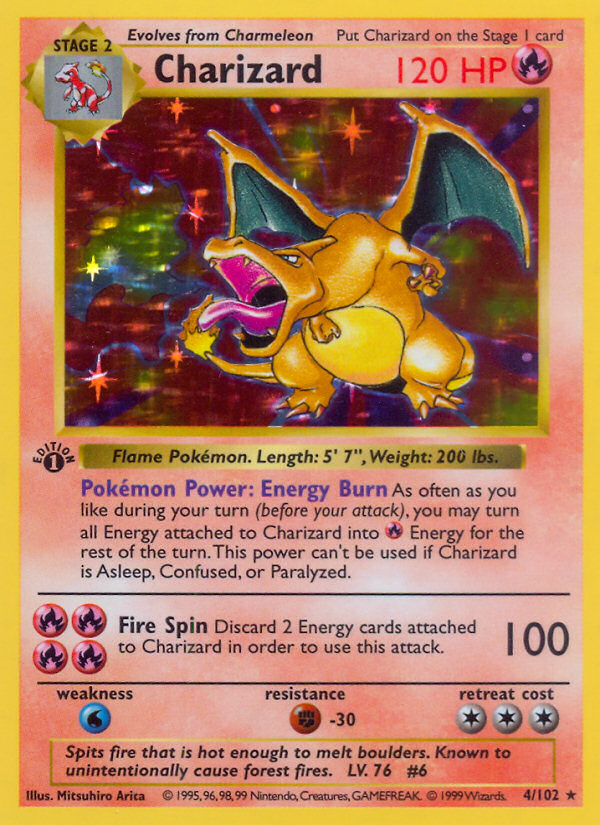
There is no trading card on Earth more famous than the 1st Edition Base Set Charizard. When people who have never collected a card in their life think of "valuable Pokémon card," this is what they picture: the holographic fire-breather that launched a million childhoods and, decades later, became a cultural phenomenon commanding prices that rival fine art.
The card was released in January 1999 as part of the English-language Base Set. The 1st Edition print run was the earliest batch, identifiable by the small "Edition 1" stamp. "Shadowless" refers to cards printed without the shadow effect behind the artwork box — a subtle distinction that separates the earliest printings from the far more common "Unlimited" version.
In the early 2010s, a PSA 10 could be purchased for $5,000–$10,000. By 2017, $30,000–$50,000. Then the pandemic-era explosion: fueled by Logan Paul's viral box breaks and a nostalgia-driven millennial buyer wave, PSA 10 copies hit $300,000–$420,000. In December 2025, a PSA 10 sold at Heritage Auctions for $550,000, setting a new record.
What makes it so scarce in top condition: in 1999, kids didn't sleeve their cards. They shuffled them, threw them in backpacks, traded on playgrounds. The holo surface was vulnerable to scratching, and the 1st Edition print run was small.
PSA has graded roughly 3,000+ copies, but only ~120 have achieved PSA 10 Gem Mint — a roughly 4% rate. That tiny population, combined with near-infinite demand, sustains six-figure prices for a piece of cardboard printed over 25 years ago.